Be yourself; Everyone else is already taken.
— Oscar Wilde.
This is the first post on my new blog. I’m just getting this new blog going, so stay tuned for more. Subscribe below to get notified when I post new updates.
Be yourself; Everyone else is already taken.
— Oscar Wilde.
This is the first post on my new blog. I’m just getting this new blog going, so stay tuned for more. Subscribe below to get notified when I post new updates.
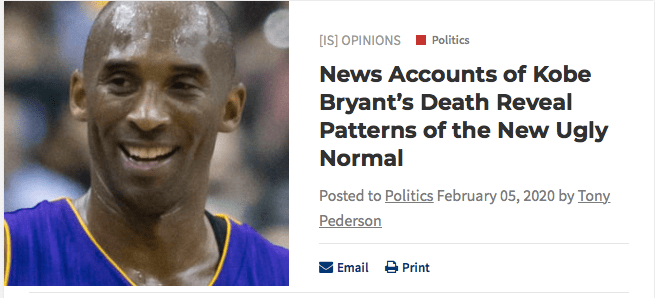
It once again wouldn’t allow me link the website so I screenshotted the title line and linked it above.
Out of the 6 articles I chose to use for this blog, this one hit me the hardest. Just reading simply the title, you know that how the news was spread after Kobe’s death is “The new ugly normal.” And honestly, I could see it get worse. This article goes down all of the routes on how the media decides to cover stories like these and found new one’s that they have yet to hit. They also mention the Washington Post reporter who was suspended from the paper for tweeting a link to a story about Kobe’s sexual assault allegations, the same day of his death.
It is just a ugly, ugly time we live in with how much coverage and access the media has and will continue to get. This article, as well as, the five before all correlated with chapter 5 from our text, Media Ethics, on privacy. They don’t have any besides inside the walls of their homes. Step foot out your house, you will be seeing a picture of you in a magazine. It has just got out of hand and like the article states, it’s not going to get better.
The ethical conflict from this article is simply, professional athletes and celebrities don’t have a right of privacy anymore. After thinking long and hard about a pro from this article, I couldn’t end up finding one or coming up with one. A con from this article is that the world we live in, with the media, is not going to get better anytime soon. My plain and simple solution to this issue is to limit the access reporters get and don’t praise news outlets for being the first to report a story.
For this article, it was one of the first one’s that brought a question to my mind. How do you truly handle grieving a public icon right away? I know the wrong way to do it, is to release the news before any kin finds out or even before first responders arrive on the scene. An important statement from this article that I found while reading was, “Experiencing breaking events in real-time is a relatively new phenomenon. On that day, it was as if the entire world was following the same Twitter timeline, waiting for more information.” The world is changing every single second and by the time the next major celebrity suddenly passes away, we could be hearing the news a completely different way. But the reason this statement stood out to me so much was because that’s exactly how myself and the 6 of my friends reacted. Just silence and reading our phones and no one knew what to say. I’m sure this is exactly what Vanessa Bryant felt, before she got the phone call confirming the article she saw on her phone.
This article relates back to our text, Media Ethics, very well. On page 155, it states about case 5-C and a case about Joe Mixon, a professional football player. His story sort of relates to Kobe’s on simply just how it was reported.
A pro to this article is that even though the media produced the news to the public prematurely, we learned a lot of what to do and what not to do. A con to this article is we still don’t know how to handle news like this properly. The ethical conflict to this story is that if you are a celebrity or if you have any significant knowledge to the public, you have no right to privacy. A solution to this article would have to be just to simply have a written rule on when you can produce the news to public and when you can’t.
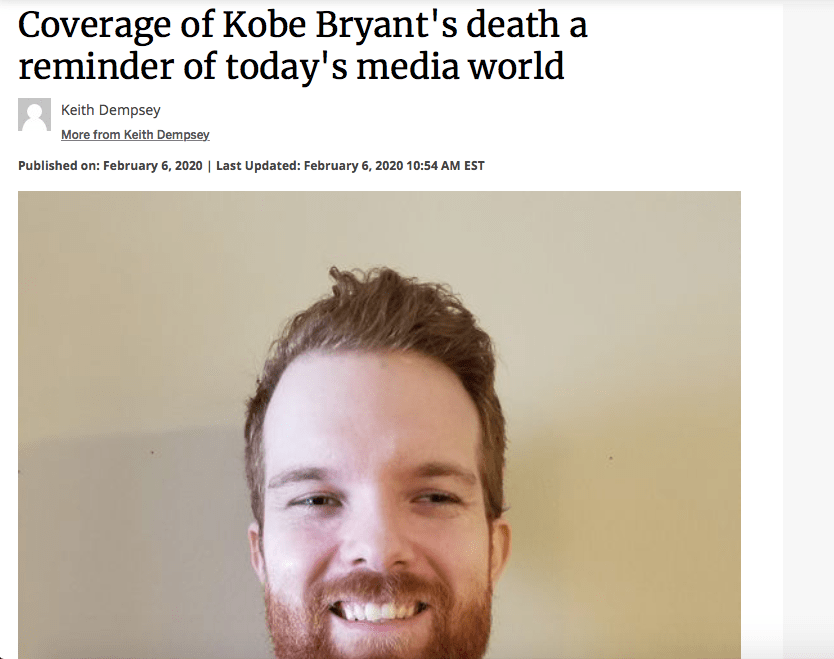
For some reason it wouldn’t let me link the website so I posted a picture of the website above.
For this article, I had to dig deep through a google search until I found this one and all I can say is, I’m glad I kept looking. Keith Dempsey does a great job using his own opinions and facts to share this story. The second paragraph of the story is what jumped out to me right away because it’s exactly what I’ve been saying for the solution I would use in these ethical conflicts. “Back in college, our journalism coordinator once told the class: you don’t report someone’s death until a doctor, the police, their employer or family says it happened. That was about 10 years ago, though, and it’s clear we live in a different world today, especially on Jan. 26.” I couldn’t agree with this anymore. Because the world has changed so dang much, and in situations like these, not for the good either. I relate this article to all of Chapter 5, Privacy, from our text, Media Ethics. It directly correlates with the chapter and the horrendous media coverage that violated many privacies.
The ethical conflict from this article is clearly once again, the way the media handled a tragic situation. A pro from this post, is the feedback Dempsey gave and the advice that some news outlets should take from it. A con from this post is the way the media handled the posting of kobe’s death. A solution I would use for this situation is exactly what Dempsey said. Just wait. Wait at least until the first responders can get to the crash scene.
https://www.cnn.com/2020/01/26/media/tmz-death-report-kobe-bryant/index.html
As many know by now but TMZ was the first media outlet to report on the death of Kobe Bryant. Although, they didn’t report any fake news, they were still way too early to report on the tragic event. Just imagine sitting at home and having the TV on or your phone open and you found out your daughter and husband just passed away in a helicopter crash. Imagine not being one of the first one’s to find out. I can’t even begin to imagine how terrible that had to feel for Vanessa Bryant, and it happened simply because news outlets can get a bonus for being the first to report. A quote from the article that I liked was, “”It would be extremely disrespectful to understand that your loved one … perished and you learn about it from TMZ,” Villanueva said. “That is just wholly inappropriate.” It was just so incredibly unprofessional but that is what TMZ is known for.
On pages 137 and 138 in the text, Media Ethics, it begins to talk about the right to privacy and in this case, Vanessa Bryant wouldn’t of been able to use this as much as a normal, non celebrity could but she defiantly deserved a little more right to privacy. The ethical conflict here is simply just TMZ being a source, dying for attention and getting it because they were so early on the news. There’s no way a wife should have to find out about a tragic event, ever again. It’s hard to find a pro from this post because it is a very negative post about TMZ and the events that followed. If I had to choose one though, I would have to say it could be used as a lesson learned. A con from this article is clear. Don’t report news before you are allowed. A solution is also just as easy. Know your place.
What I like the most about this article is the title, “Media coverage of Kobe Bryant’s death was a chaotic mess, but there were moments of grace.” The reason I like this article’s title so much is that, that’s the perfect way to describe that day or even the week. At first, it was all chaotic, no one knew what to think, do, believe or say. But after all the dust settled and the news that first broke out was confirmed, grace in sued. Tributes were sent out left and right and people shared their favorite memories. Many, including I, shed tears. He was a staple to every basketball fan.
On page 131 of the text, Media Ethics, case 4-H is listed and the title of that case is “How one tweet ruined a life.” The reason I am correlating this article with this case is because many reporters got death threats after spreading false information that day. People these days are absolutely brutal on social media and the internet and many times, people’s lives can be changed by people’s comments. The ethical conflicts related to this article are very similar to my first post and will be similar with all my other posts as well but the ethical conflicts in this article are clearly just information that wasn’t ready to be released to the public. The pro of this article is that even though there was a large chaotic mess at the beginning, people were able to dig deep to show moments of grace. A clear con of this article is that once a rumor about something this big in caliber, it will snowball and snowball fast. I have the same solution for this post as I did from my last and that is just wait. Just wait until you know for sure what happened so this doesn’t have to happen.
The media is always constantly looking to be the first to report any breaking news there could be and often, some of the first sources to come out, often do not have all of the correct facts. In the example I will be using to show this, I chose to use Kobe Bryant’s death. Kobe Bryant was a hall of fame basketball player who suddenly passed away in a tragic plane crash with his daughter and others. As soon as news broke to the media that Kobe Bryant’s helicopter had crashed, the first articles were stated that his whole family was in the helicopter, which turned out to be very false. During the course of my blog posts, I will be taking a look at articles that described what on that day and what could’ve been different.
Starting with the Boston Globe article, that is titled, “How did the media report Kobe Bryant’s death? With confusion and misinformation, to start,” I believe was the perfect place to start. The first paragraph of the whole article is what stood out to be the most. It states, “Monitoring the media coverage in the aftermath of Kobe Bryant’s death in a helicopter crash Sunday has provided yet another reminder of the importance of knowing whom to trust and whom to dismiss in the chaotic real-time matters of major breaking news.” This stood out to me the most because it relates to Chapter 4, Loyalties, in our text so well. On page 98 in Media Ethics, it says that when reporters and journalists decide to take on a project or story, they are taking on all of the loyalties that come with it, which includes presenting the facts in a loyal way.
Throughout the Boston Globe’s article, it simply just goes through different news stations and how they reacted to the news, included tweets from various news articles, that had misleading information. Obviously, the ethical conflict with this issue is that many people were on social media and the internet as soon as the news broke out, and whatever they were to read, they were to believe it. This happening, caused even more panic because no one knew what to believe and people started any rumor they could make. The pro’s and con’s for this are a little hard to determine. Obviously a con would be that the public would have a misconception of what was going on and rumors could spiral out of control. A pro could be that if one the first articles that were to be released, had all the right facts, you could avoid the whole mess. A solution to this in my opinion could be simple but it’s not as simple as I make it out to be. My solution would just to be to wait until the main facts before anything was released or there would be punishments for misleading articles.
This is an example post, originally published as part of Blogging University. Enroll in one of our ten programs, and start your blog right.
You’re going to publish a post today. Don’t worry about how your blog looks. Don’t worry if you haven’t given it a name yet, or you’re feeling overwhelmed. Just click the “New Post” button, and tell us why you’re here.
Why do this?
The post can be short or long, a personal intro to your life or a bloggy mission statement, a manifesto for the future or a simple outline of your the types of things you hope to publish.
To help you get started, here are a few questions:
You’re not locked into any of this; one of the wonderful things about blogs is how they constantly evolve as we learn, grow, and interact with one another — but it’s good to know where and why you started, and articulating your goals may just give you a few other post ideas.
Can’t think how to get started? Just write the first thing that pops into your head. Anne Lamott, author of a book on writing we love, says that you need to give yourself permission to write a “crappy first draft”. Anne makes a great point — just start writing, and worry about editing it later.
When you’re ready to publish, give your post three to five tags that describe your blog’s focus — writing, photography, fiction, parenting, food, cars, movies, sports, whatever. These tags will help others who care about your topics find you in the Reader. Make sure one of the tags is “zerotohero,” so other new bloggers can find you, too.

 Carter Siedel's 487 Blog